
Why Six Months of Savings Makes Transition Easier
Time becomes an asset when cash is available

Disclosure:
This article is for educational purposes only and is not financial advice. Always do your own research or speak with a licensed advisor before making investment decisions.
Why Transitions Feel Financially Unstable Without Savings
Income uncertainty increases immediately after leaving the Army. Even with a job lined up, pay timing, benefits, and onboarding delays are common. Those gaps create stress quickly. Stress pressures soldiers to accept the first option available. First options are rarely the best options. Better options require time.
Civilian expenses behave differently than military pay systems. Costs like healthcare, transportation, and housing are less predictable. Predictability is replaced with variability. Variability makes budgeting harder. Harder budgeting increases anxiety. Anxiety leads to reactive spending.
Unexpected costs appear during almost every transition. Licenses, equipment, travel, and professional expenses stack early. These costs are often underestimated. Underestimation drains reserves faster than planned. Fast depletion creates urgency.
Lack of savings narrows decision-making. When cash is tight, flexibility disappears. Decisions become survival-based instead of strategic. Survival decisions often sacrifice long-term outcomes. Long-term outcomes matter most during transition.
How Six Months of Savings Creates Control
Savings buy time to make thoughtful decisions. Time allows evaluation of opportunities. Evaluation improves choice quality. Better choices lead to better outcomes. Outcomes compound over time.
This buffer aligns with the 56K Plan philosophy. The plan emphasizes margin and consistency. Transition savings protect that margin during change. Protection preserves discipline. Discipline carries into civilian life.
Savings reduce pressure to rely on debt. Debt feels like a solution under stress. That solution often creates long-term drag. Avoiding debt preserves future cash flow. Preserved cash flow supports investing consistency.
Confidence increases when basic needs are covered. Confidence lowers stress. Lower stress improves performance in interviews, negotiations, and decisions. Improved performance increases opportunity quality. Opportunity quality shapes career trajectory.
Why Strong Savings Support Long-Term Freedom
Six months of savings protects the $3 Million Timeline. Interruptions during transition can delay investing for years. Savings prevent those interruptions. Prevention is more powerful than recovery.
Financial buffers improve adaptability. Career paths rarely move in straight lines. Savings allow course correction. Course correction preserves momentum. Momentum compounds.
Stress reduction improves long-term discipline. Financial stress erodes habits. Reduced stress protects habits. Habits build wealth quietly.
Freedom grows when transitions are optional, not forced. Optionality is leverage. Leverage creates calm. Calm supports consistency.
Simple actions that strengthen your transition buffer
Set a six-month savings target based on civilian expenses. Specific numbers drive action.
Automate savings well before ETS. Early automation reduces effort.
Keep transition savings separate from other goals. Separation protects purpose.
Avoid new long-term commitments in the final year. Flexibility matters most.
Final Word
Transitioning out of the Army is easier when time is on your side. Six months of savings creates that time by removing urgency and pressure. Soldiers with strong buffers make better decisions, avoid bad debt, and protect long-term momentum. Savings do not eliminate uncertainty, but they make uncertainty manageable. When transitions are handled calmly, freedom becomes easier to sustain while you serve and beyond.
Recommended Tools for Soldiers
📈 Investing Hub – Resume compounding smoothly once income stabilizes.
🪙 High-Yield Savings Hub – Hold transition funds safely while maintaining liquidity.
More to explore:
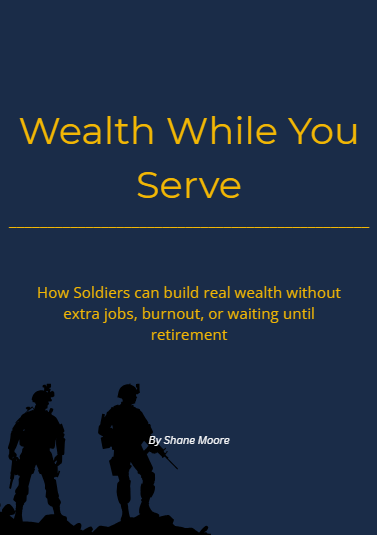
Ready to Start Building Wealth While You Serve?
Grab the free guide built for service members who want more than just survival mode. Whether you're in the barracks or deployed overseas, this is your first step toward real freedom.
Helping Soldiers Build Real Wealth While They Serve
We share practical tools, smart financial strategies, and military-friendly resources. Our goal is to help you stop just surviving and start building real freedom.

The information provided by Wealth While You Serve is for educational purposes only and does not constitute financial, legal, or tax advice. Always consult a qualified advisor before making financial decisions. Some links on this site are affiliate links, which means we may earn a small commission at no extra cost to you. This helps us continue offering free resources for military members and their families.
Created with ©systeme.io